Used Škoda Enyaq: Battery, Variants, SoH
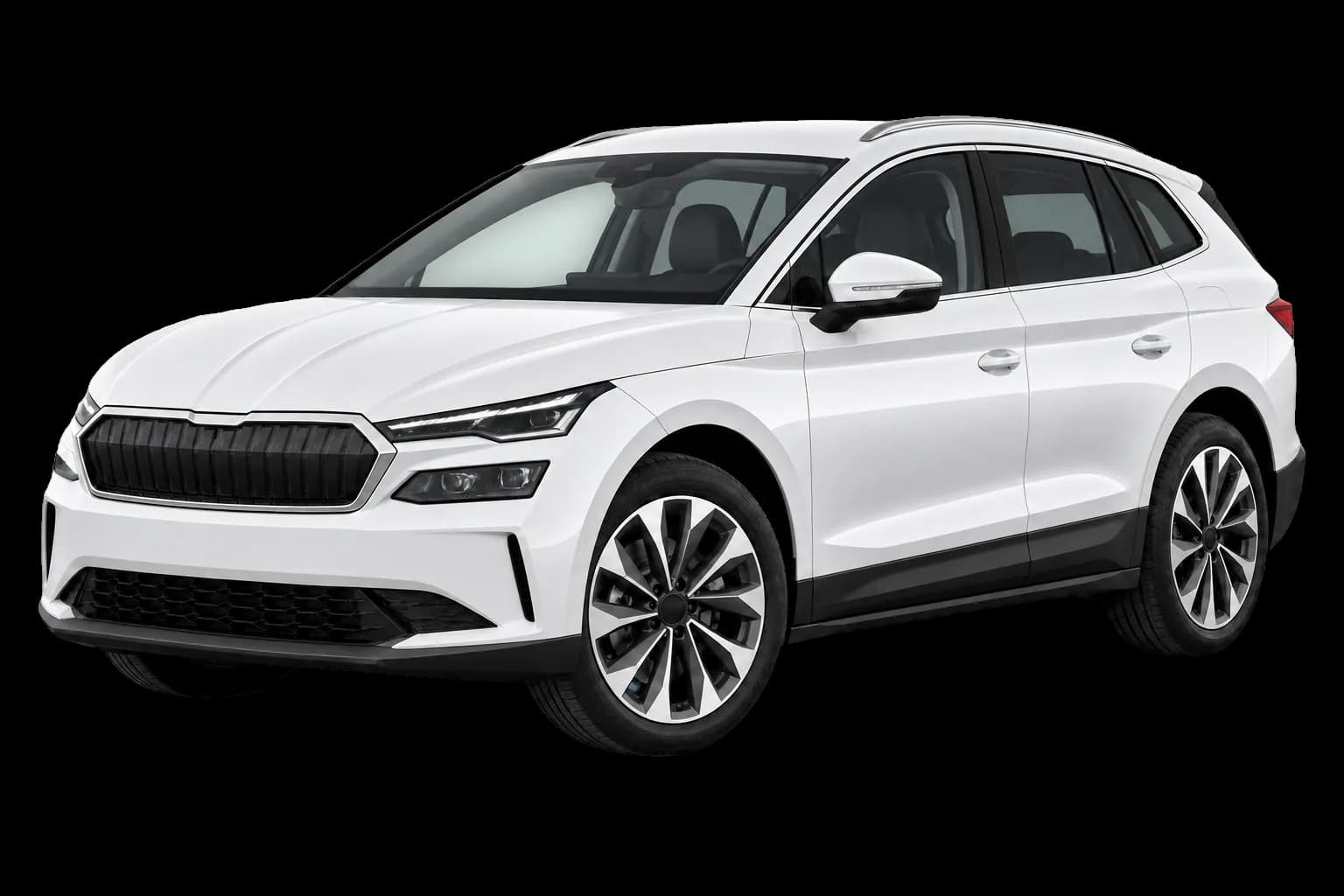
Variants & batteries at a glance
| Variant | Period (EU) | Usable capacity | Cell chemistry |
|---|---|---|---|
| iV 50 (55 kWh) | 2021 – 2023 | 52 | NMC |
| iV 60 (62 kWh) | 2021 – 2024 | 58 | NMC |
| iV 80 / 80x / RS (82 kWh) | 2021 – 2023 | 77 | NMC |
| 85 / 85x (model-year update, 82 kWh) | 11/2023 – 2024 | 77 | NMC |
| Facelift: 60 / 85 / 85x / RS | since 1/2025 | 59 · 77 · 79 | NMC |
iV 50 (55 kWh) (2021 – 2023)
| Period | net kWh | Chemistry | Cells |
|---|---|---|---|
| 2021 – 2023 | 52 | NMC | MEB pack, pouch cells, 8 modules (24 cells each) |
The rear-drive base variant with 109 kW was the rarest in the line-up — the used market is correspondingly thin. Technically it is the same MEB pack as in the larger variants, just with fewer modules.
AC only 7.2 kW (two-phase), DC up to 110 kW per factory spec — early cars considerably below that depending on the ordered charging package. Check the actual charging power before buying.
Battery warranty for this variant: 8 years / 160,000 km (70% minimum capacity).
iV 60 (62 kWh) (2021 – 2024)
| Period | net kWh | Chemistry | Cells |
|---|---|---|---|
| 2021 – 2024 | 58 | NMC | MEB pack, pouch cells, 9 modules (24 cells each) |
The iV 60 shares its 58 kWh pack with the VW ID.3 Pro. As with all MEB cars, the battery care mode with its 80% charge limit (from software ME3) is the sensible everyday setting.
AC 11 kW, DC 100 kW from the factory — 120 kW with the free ME3 software update (from 2022). Whether ME3 is installed belongs on the buying checklist.
Battery warranty for this variant: 8 years / 160,000 km (70% minimum capacity).
iV 80 / 80x / RS (82 kWh) (2021 – 2023)
| Period | net kWh | Chemistry | Cells |
|---|---|---|---|
| 2021 – 2023 | 77 | NMC | MEB pack, pouch cells, 12 modules (24 cells each) |
The large pack is identical to the one in the VW ID.3 Pro S from the ADAC endurance test — the best-documented MEB battery there is: around 91% SoH at 160,000 km and roughly 89% at 220,000 km despite hard use. An independently measured Enyaq iV 80 in an AutoScout24 used-car check came in at 94.0% after 56,500 km.
DC 125 kW from the factory, 135 kW with ME3; AC 11 kW. 80x and RS with all-wheel drive (195 and 220 kW), same battery.
Battery warranty for this variant: 8 years / 160,000 km (70% minimum capacity).
85 / 85x (model-year update, 82 kWh) (11/2023 – 2024)
| Period | net kWh | Chemistry | Cells |
|---|---|---|---|
| 11/2023 – 2024 | 77 | NMC | MEB pack, pouch cells, 12 modules |
With the model-year update, the 85 and 85x (210 kW each) replaced the 80 variants — battery capacity stayed the same while efficiency and charging power improved.
DC up to 135 kW, the 85x up to 175 kW (10–80% in 28 minutes). AC 11 kW.
Battery warranty for this variant: 8 years / 160,000 km (70% minimum capacity).
Facelift: 60 / 85 / 85x / RS (since 1/2025)
| Period | net kWh | Chemistry | Cells |
|---|---|---|---|
| from 1/2025 (60) | 59 | NMC | MEB pack |
| from 1/2025 (85/85x) | 77 | NMC | MEB pack |
| from 1/2025 (RS) | 79 | NMC | MEB pack |
The facelift is still young for the used market; long-term figures naturally do not exist yet. The packs remain MEB technology of the known generations.
DC: 60 up to 165 kW, 85 up to 135 kW, 85x up to 175 kW, RS up to 185 kW. AC 11 kW throughout.
Battery warranty for this variant: 8 years / 160,000 km (70% minimum capacity).
The Enyaq is Škoda's MEB best-seller and has arrived in the used market in volume: 2021 cars start at around €16,000, with the bulk of early iV 60 and iV 80 examples between €22,000 and €34,000. On the battery side, the Enyaq benefits from the best-documented battery pack in the entire VW Group.
The MEB advantage: another car's endurance test that counts for the Enyaq
There is no ADAC endurance test of the Enyaq itself — but its 77 kWh pack is identical to that of the VW ID.3 Pro S, which the ADAC measured over years: around 91% SoH at 160,000 km, roughly 89% at 220,000 km, despite deliberately hard use with plenty of rapid charging. For an MEB car like the Enyaq, that is the most robust long-term reference available. Enyaq-specific, the AutoScout24 used-car check fits the picture: a 2021 iV 80 measured independently came in at 94.0% after 56,500 km.
What to check before buying
- ME3 installed? The free update fitted at a garage raises DC charging power noticeably (58 kWh: 100 → 120 kW; 82 kWh: 125 → 135 kW) and adds the battery care mode. Early used cars without ME3 charge distinctly more slowly — the retrofit is free but costs a day at the garage.
- Service action 93PM done? Owners report a service action in which individual battery modules were replaced as a precaution. Ask the dealer or Škoda partner whether the car was affected and the action has been carried out.
- Keep an eye on the 12 V battery. The MEB-typical weak spot: error messages and aborted charging sessions often trace back to the small starter battery, not the high-voltage pack.
- Get the SoH documented. Like the ID.3, the Enyaq can be read out via an OBD dongle ('Maximum Energy Content' divided by net rated capacity). That is a snapshot of the BMS estimate — fine for the buying decision; as proof towards the next buyer, the history over time is what counts.
Context: recalls and defect statistics
According to the ADAC recall notice, the Enyaq is not affected by the large 2025 MEB battery recall (VW ID.3/ID.4/ID.5/ID. Buzz, Cupra Born). In the TÜV Report 2026, the defect rate of 2–3-year-old Enyaqs is 9.1% — higher than the ID.3 (5.5%); the typical items are EV-usual wear topics such as axle suspension and brakes, not the traction battery.
Battery warranty
Škoda warrants the battery for 8 years with at least 70% remaining capacity. Mileage limits and exceptions are shown with the variants above and in the questions below.